
Interest Rate Converter is one of the most useful tools for understanding how loan interest works. Whether you are planning to take a home loan, personal loan, education loan, car loan, or use a credit card, you will often see interest rates shown in different ways. Some lenders advertise an annual interest rate, while others calculate interest every month or even every day. This difference can make it difficult to compare loan offers and understand the actual cost of borrowing.
Knowing how Interest Rate Conversion works helps you compare loan offers fairly, estimate your EMI more accurately, and understand how lenders calculate interest over different time periods. It also makes it easier to choose a loan that suits your budget and financial goals.
In this guide, you’ll learn how to convert annual, monthly, and daily interest rates using simple formulas, easy examples, and comparison tables. You’ll also understand the difference between simple and compound interest, nominal and effective interest rates, and how these conversions can affect your total loan cost.
What Is Interest Rate Conversion?
Interest Rate Conversion means changing an interest rate from one time period to another without changing its actual value. For example, you can convert an annual interest rate into a monthly or daily rate to understand how interest is calculated over different periods.
Many banks, NBFCs, and financial institutions use different interest calculation methods depending on the type of loan. Understanding these conversions helps borrowers compare loan offers more accurately.
Meaning
Simply put, interest rate conversion answers questions like:
What is a 12% annual interest rate per month?
How much is 10% interest per day?
How can you convert monthly interest into an annual rate?
Instead of guessing, borrowers can use an Interest Rate Converter or simple mathematical formulas to calculate the correct value.
Example
Suppose a bank offers a loan at 12% per year.
Using a simple conversion:
Annual Rate = 12%
Monthly Rate = 12 ÷ 12 = 1%
Daily Rate = 12 ÷ 365 = 0.0329%
This makes it easier to understand how interest is charged over different periods.
Why Borrowers Should Understand It
Understanding Interest Rate Conversion helps you compare loan offers fairly, estimate your EMI more accurately, avoid calculation mistakes, and make better borrowing decisions.
Types of Interest Rates
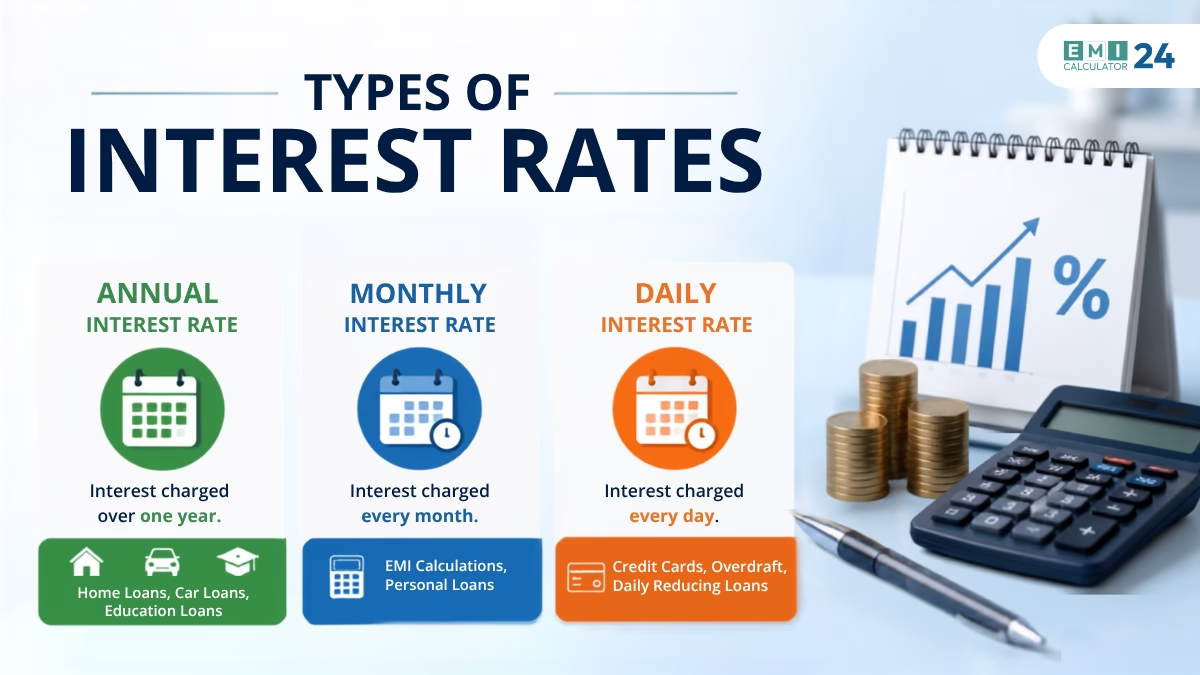
Interest rates are usually expressed in different time periods depending on the financial product. The three most common types are annual, monthly, and daily interest rates.
Understanding each type helps borrowers calculate loan costs correctly and compare lending options with confidence.
1. Annual Interest Rate
An annual interest rate shows how much interest is charged over one year.
This is the most common rate displayed for:
Home loans
Personal loans
Car loans
Education loans
Business loans
Example:
If your loan carries an annual interest rate of 9%, the lender charges 9% interest over one year before considering repayment schedules or compounding.
Many people later perform an Annual Interest Rate to Monthly conversion to estimate monthly borrowing costs.
2. Monthly Interest Rate
A monthly interest rate represents the interest charged every month.
Most EMI-based loans calculate interest monthly because borrowers make monthly repayments.
Example:
Annual Interest = 12%
Monthly Interest
= 12 ÷ 12
= 1% per month
Many borrowers search for Convert Monthly Interest Rate to Annual when comparing short-term and long-term loan offers.
3. Daily Interest Rate
Some lenders calculate interest every single day on the outstanding loan balance.
Daily calculations are commonly used in:
Credit cards
Overdraft facilities
Loan overdrafts
Certain personal loans
Daily reducing balance loans
Daily interest provides greater accuracy because interest is charged only for the exact number of days the money remains unpaid.
Many borrowers also use an annual to daily interest rate calculator to estimate daily borrowing costs before taking a loan.
Quick Comparison
| Interest Type | Time Period | Common Use |
|---|---|---|
| Annual Interest Rate | 1 Year | Home Loan, Car Loan, Education Loan |
| Monthly Interest Rate | 1 Month | EMI Calculations |
| Daily Interest Rate | 1 Day | Credit Cards, Overdraft, Daily Reducing Loans |
Why Do Banks Convert Interest Rates?
Banks and financial institutions do not use the same interest calculation method for every loan.
Lending practices and interest rate calculations may vary across financial institutions. The Reserve Bank of India (RBI) provides regulatory guidelines that banks are required to follow.
The way interest is charged depends on the loan type, repayment schedule, and banking policies. That is why lenders perform Interest Rate Conversion before calculating interest, EMI, or the total repayment amount.
Understanding this process helps borrowers compare loans more accurately and avoid confusion when different lenders advertise rates in different formats.
1. EMI Calculations
Most home loans, personal loans, and car loans are repaid through Equated Monthly Installments (EMIs). Since borrowers pay every month, banks first convert the annual interest rate into a monthly rate before calculating the EMI.
For example:
Annual Interest Rate = 12%
Monthly Interest Rate = 12% ÷ 12 = 1%
This monthly rate is then used in the EMI formula.
Why it matters:
If you understand this conversion, it becomes easier to estimate your monthly repayment before applying for a loan.
2. Credit Cards
Credit card companies usually calculate interest every day instead of every month. Interest is charged only on the outstanding balance and for the exact number of days the payment remains unpaid.
For example:
Annual Interest Rate = 18%
Daily Interest Rate = 18% ÷ 365 = 0.0493%
This daily rate is multiplied by the outstanding balance every day until the payment is made.
Tip: Many people search for APR to interest rate conversion because credit card interest is commonly shown as an Annual Percentage Rate (APR).
3. Personal Loans
Personal loans generally follow a monthly reducing balance method. Every EMI reduces the principal amount, and interest is calculated only on the remaining balance.
To understand how this differs from flat-rate loans, read our comparison of Flat vs Reducing Interest Rate before choosing a lender.
This method ensures that borrowers pay interest only on the unpaid portion of the loan.
4. Home Loans
Home loans usually have longer repayment periods, often ranging from 10 to 30 years. Since EMIs are paid every month, banks convert the yearly interest rate into a monthly rate for EMI calculations.
Before applying, it’s also worth understanding the difference between Fixed vs Floating Interest Rate, as your choice can affect future EMIs and overall borrowing costs.
If you choose a fixed rate home loan, remember that the fixed rate loan lock-in period may affect your ability to refinance or switch lenders. During the home loan lock-in period, some banks may also apply fixed loan exit charges if you close the loan early.
Before signing any agreement, always check the fixed rate home loan rules and understand the lock-in period in loan documents provided by the lender.
5. Daily Reducing Balance Loans
Some banks calculate interest on a daily reducing balance instead of a monthly reducing balance.
In this method:
Interest is calculated every day.
Whenever you make a payment, the principal reduces immediately.
As the principal decreases, future interest is applied only to the remaining amount owed.
This approach can lower the total interest paid, especially when borrowers make part-payments before their EMI due date.
Summary Table
| Loan Type | Interest Calculation | Why Conversion Is Needed |
|---|---|---|
| Home Loan | Monthly | EMI Calculation |
| Personal Loan | Monthly | Monthly Reducing Balance |
| Credit Card | Daily | Outstanding Balance |
| Car Loan | Monthly | EMI Calculation |
| Overdraft | Daily | Daily Outstanding Balance |
Annual to Monthly Interest Rate Formula
One of the most common questions about Interest Rate Conversion is how to convert an annual interest rate into a monthly rate. This conversion is useful because most EMIs are paid every month, while loan advertisements usually display annual interest rates.
There are two ways to perform this conversion depending on whether you use simple interest or compound interest.
Simple Formula
The easiest method is simple division.
Formula:
Monthly Interest Rate = Annual Interest Rate ÷ 12
Example
Annual Interest Rate = 12%
Monthly Interest Rate
= 12 ÷ 12
= 1% per month
This method is easy to understand and is commonly used for basic calculations.
Worked Example
Suppose Rahul takes a personal loan with an annual interest rate of 9.6%.
Monthly Interest Rate
= 9.6 ÷ 12
= 0.80% per month
If the loan amount is ₹5,00,000, this monthly rate becomes the basis for EMI calculations.
Effective Monthly Conversion
When interest compounds monthly, the calculation changes slightly.
Formula:
Monthly Rate
= (1 + Annual Rate)^(1/12) − 1
Example:
Annual Rate = 12%
Monthly Effective Rate
≈ 0.949%
This value is slightly different from 1% because compounding is taken into account.
If you’re new to compounding, read our detailed guide on Compound Interest in Loans Explained to understand how it affects your loan repayment over time.
Common Mistakes
Many borrowers make small calculation errors that can lead to incorrect loan comparisons.
1. Assuming every bank uses the same formula
Different lenders may use simple interest, compound interest, monthly reducing balance, or daily reducing balance methods.
2. Ignoring compounding
Simply dividing the annual rate by 12 is not always accurate when compound interest applies.
3. Comparing different rate types
Always compare annual rates with annual rates and monthly rates with monthly rates. Mixing different periods can lead to misleading conclusions.
4. Forgetting processing charges
Interest is only one part of the borrowing cost. Processing fees, insurance, taxes, and other charges also affect the total loan cost.
Quick Example Table
| Annual Rate | Monthly Rate (Simple) | Monthly Rate (Effective) |
|---|---|---|
| 6% | 0.50% | 0.4868% |
| 8% | 0.67% | 0.6434% |
| 10% | 0.83% | 0.7974% |
| 12% | 1.00% | 0.9489% |
| 15% | 1.25% | 1.1715% |
Note: The “Simple” column uses annual rate ÷ 12, while the “Effective” column considers monthly compounding.
Annual to Daily Interest Rate Formula
Banks that calculate interest every day first convert the annual rate into a daily rate. This calculation method is widely used for products such as credit cards, overdrafts, and selected business financing options.
365-Day Method
This is the most widely used method in India.
Formula
Daily Interest Rate = Annual Interest Rate ÷ 365
Example
Annual Rate = 12%
Daily Rate
= 12 ÷ 365
= 0.0329% per day
360-Day Method
Some international banks and financial institutions use a 360-day year for interest calculations.
Formula
Daily Interest Rate = Annual Interest Rate ÷ 360
Example
Annual Rate = 12%
Daily Rate
= 12 ÷ 360
= 0.0333% per day
Although the difference seems small, it can slightly increase the total interest paid over a long loan period.
When Is Each Method Used?
| Method | Days Used | Common Applications |
|---|---|---|
| 365-Day Method | 365 | Home Loans, Personal Loans, Savings Accounts |
| 360-Day Method | 360 | Some Corporate Loans, International Banking, Commercial Lending |
Always read your loan agreement carefully to know which method your lender follows before comparing interest rates.
Monthly to Annual Interest Rate Formula
Sometimes banks, finance companies, or investment products mention a monthly interest rate instead of an annual rate. Interest Rate Conversion also works in reverse, allowing borrowers to convert a monthly interest rate into an annual rate for a fair comparison.
This conversion gives a clearer picture of the total borrowing cost over one year and makes it easier to compare different loan offers.
There are two common ways to convert a monthly rate into an annual rate: simple conversion and effective conversion.
Simple Conversion
The simplest method is to multiply the monthly interest rate by 12.
Formula
Annual Interest Rate = Monthly Interest Rate × 12
This method is easy to calculate and is commonly used for basic loan comparisons.
Example
Suppose a lender charges 1% interest per month.
Annual Interest Rate
= 1 × 12
= 12% per year
This method works well for simple interest calculations where compounding is not involved.
Effective Conversion
If interest is compounded every month, the actual annual interest becomes slightly higher than the simple multiplication result.
Formula
Effective Annual Rate = (1 + Monthly Rate)¹² − 1
Example
Monthly Interest Rate = 1%
Effective Annual Rate
= (1 + 0.01)¹² − 1
≈ 12.68%
Although the monthly rate is only 1%, monthly compounding increases the actual annual borrowing cost.
This is one reason why borrowers should understand the difference between a nominal rate and an effective rate before comparing loans.
Daily to Annual Interest Rate Formula
Daily interest calculations are common in credit cards, overdrafts, and certain business loans. If you know the daily rate, converting it into an annual rate helps you understand the overall borrowing cost more clearly.
If you’d like to see how lenders calculate interest on a day-to-day basis, check our guide on Daily Interest Calculation in Personal Loan with practical examples.
Formula
Annual Interest Rate = Daily Interest Rate × 365
If a lender uses the 360-day convention, multiply by 360 instead.
Example 1
Daily Interest Rate = 0.03%
Annual Interest Rate
= 0.03 × 365
= 10.95%
Example 2
Daily Interest Rate = 0.05%
Annual Interest Rate
= 0.05 × 365
= 18.25%
Real-Life Loan Example
Suppose Amit uses a credit card and carries an unpaid balance of ₹50,000.
The card charges 0.0493% interest per day.
Annual Interest Rate
= 0.0493 × 365
≈ 18%
If Amit delays repayment for several months, daily interest continues to accumulate, increasing the total amount payable.
Understanding how to convert daily interest rate to annual allows borrowers to estimate long-term borrowing costs more accurately.
Simple Interest vs Compound Interest Conversion
Many people assume that all interest rates work in the same way. In reality, banks use different calculation methods depending on the type of loan or financial product.
Knowing the difference between simple and compound interest helps you understand why two loans with the same advertised interest rate may have different repayment amounts.
What Is Simple Interest?
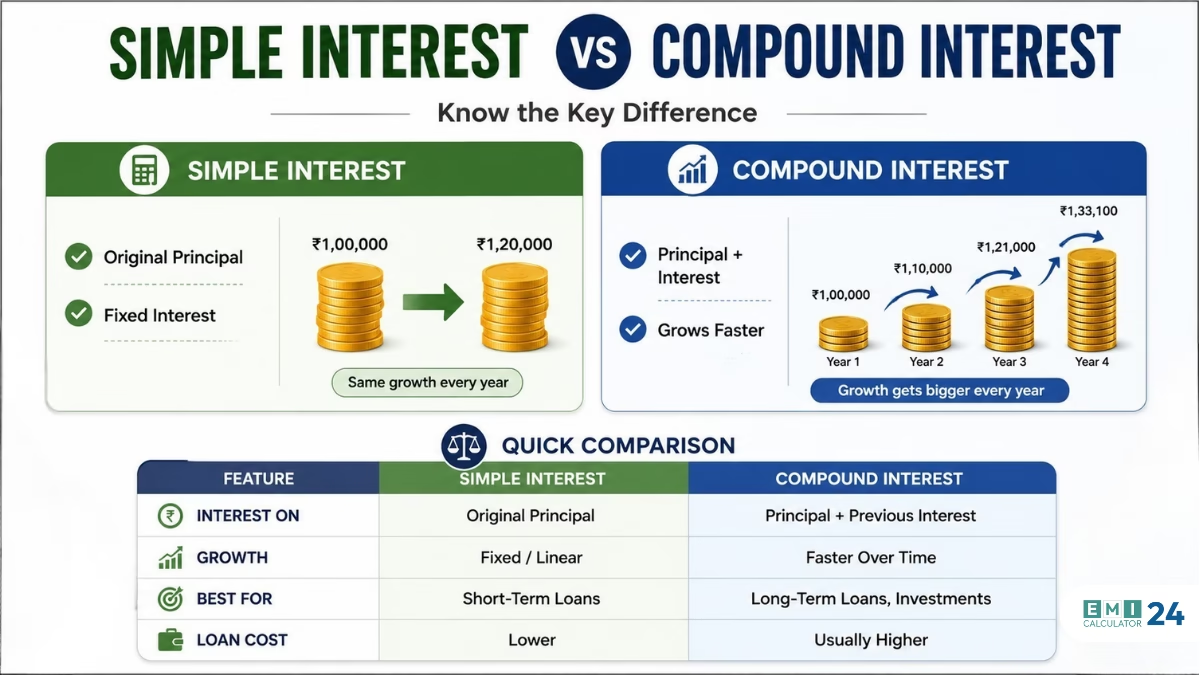
Simple interest is calculated only on the original principal amount.
The interest remains the same throughout the loan period.
Formula
Simple Interest = (Principal × Rate × Time) ÷ 100
What Is Compound Interest?
Compound interest is calculated on both the principal and the interest already added to the loan.
Because of compounding, the total borrowing cost gradually increases over time.
Formula
Amount = Principal × (1 + Rate / n)^(n × Time)
Where:
Principal = Original loan amount
Rate = Annual interest rate
n = Number of compounding periods
Time = Loan duration
Comparison Table
| Feature | Simple Interest | Compound Interest |
|---|---|---|
| Interest Calculated On | Original Principal | Principal + Previous Interest |
| Growth | Linear | Faster over time |
| Formula | P × R × T ÷ 100 | P × (1 + r/n)^(nt) |
| Loan Cost | Lower | Usually Higher |
| Common Uses | Short-Term Loans | Home Loans, Investments, Credit Cards |
Nominal Interest Rate vs Effective Interest Rate
Many borrowers think the nominal interest rate and effective interest rate are the same. However, they are different, especially when interest is compounded. Knowing the difference helps you compare loans more accurately.
What Is a Nominal Interest Rate?
A nominal interest rate is the annual rate advertised by the lender. It does not consider how often interest is compounded during the year.
Example: A lender advertises a home loan at 10% per year. This is the nominal rate.
What Is an Effective Interest Rate?
An effective interest rate includes the effect of compounding. It shows the actual cost of borrowing over one year.
For example, if a loan charges 10% annually but compounds every month, the effective annual rate will be slightly higher than 10%.
Quick Comparison
| Feature | Nominal Interest Rate | Effective Interest Rate |
|---|---|---|
| Includes Compounding | ❌ No | ✅ Yes |
| Used in Advertisements | ✅ Yes | Sometimes |
| Shows Actual Borrowing Cost | ❌ No | ✅ Yes |
| Better for Loan Comparison | ❌ No | ✅ Yes |
Tip: Whenever you compare two loan offers, check whether the quoted interest rate is nominal or effective.
Annual vs Monthly vs Daily Interest Rate Comparison
Although all three rates represent the cost of borrowing, they are used for different purposes.
| Interest Type | Formula | Best Used For | Common Loan Types |
|---|---|---|---|
| Annual Interest Rate | Base Rate | Comparing loan offers | Home Loan, Car Loan, Education Loan |
| Monthly Interest Rate | Annual ÷ 12 | EMI Calculation | Personal Loan, Home Loan |
| Daily Interest Rate | Annual ÷ 365 | Daily Interest Calculation | Credit Card, Overdraft |
Which One Should You Compare?
Compare annual rates while choosing a lender.
Use monthly rates to estimate EMIs.
Check daily rates if your loan or credit card calculates interest every day.
How Interest Rate Conversion Affects EMI
Even a small difference in Interest Rate Conversion can affect your monthly EMI and the total interest you pay over the loan period. Since most lenders calculate EMIs using a monthly interest rate, understanding how an annual rate is converted helps you estimate your repayments more accurately and compare loan offers with confidence.
You can also use our Loan EMI Calculator Online to estimate your monthly repayments using different interest rates and loan tenures.
Let’s understand this with simple examples.
Example 1: ₹5 Lakh Personal Loan
Loan Amount: ₹5,00,000
Loan Tenure: 5 Years
Annual Interest Rate: 10%
Monthly Interest Rate
= 10 ÷ 12
= 0.833%
This monthly rate is used to calculate your EMI.
If the lender uses a different compounding method, the EMI may vary slightly.
Example 2: ₹10 Lakh Home Loan
Loan Amount: ₹10,00,000
Loan Tenure: 20 Years
Annual Interest Rate: 8.5%
Monthly Interest Rate
= 8.5 ÷ 12
≈ 0.708%
Even a difference of 0.10% in the interest rate can increase the total repayment by thousands of rupees over a long loan tenure.
That is why understanding Interest Rate Conversion is important before selecting any loan.
Common Interest Rate Conversion Mistakes
Many borrowers make simple mistakes while converting interest rates. These errors can lead to incorrect loan comparisons and poor financial decisions.
1. Dividing by 12 Without Checking Compounding
Simple division works only for basic calculations. If the lender uses monthly compounding, the actual annual cost will be different.
2. Ignoring the Effective Annual Rate
Comparing only nominal interest rates may give a misleading picture of the total borrowing cost.
3. Confusing the 360-Day and 365-Day Methods
Some lenders calculate daily interest using 365 days, while others use 360 days.
4. Mixing APR with Periodic Interest Rates
APR includes additional borrowing costs in some financial products.
A monthly interest rate and APR should never be treated as the same value.
5. Comparing Different Time Periods
Do not compare:
❌ Monthly Interest Rate with Annual Interest Rate
Always convert both rates into the same period before comparing.
Easy Interest Rate Conversion Table
The table below uses the simple conversion method (Annual Rate ÷ 12 and Annual Rate ÷ 365).
| Annual Rate | Monthly Rate | Daily Rate |
|---|---|---|
| 6% | 0.50% | 0.0164% |
| 8% | 0.67% | 0.0219% |
| 10% | 0.83% | 0.0274% |
| 12% | 1.00% | 0.0329% |
| 15% | 1.25% | 0.0411% |
Note: These values are calculated using the simple conversion method. If your lender uses compound interest, the actual effective rate may be slightly different.
Frequently Asked Questions (FAQs)
Q1. Is annual interest divided by 12?
Yes. For simple calculations, the monthly interest rate is found by dividing the annual interest rate by 12. However, if interest compounds monthly, the effective monthly rate will be slightly different.
Q2. Is daily interest divided by 365?
In most cases, yes. Many banks calculate daily interest using a 365-day year. Some financial institutions may use a 360-day convention, so always check your loan agreement.
Q3. Does interest rate conversion change my EMI?
The conversion itself does not change the EMI. However, the method used by the lender—such as simple interest, compound interest, or daily reducing balance—can affect the final EMI amount.
Q4. What is APR?
APR (Annual Percentage Rate) represents the yearly cost of borrowing. Depending on the product and regulations, it may include interest and certain additional charges, making it useful for comparing loan offers.
Q5. Can I calculate interest rate conversion myself?
Yes. You can use simple formulas or an online calculator to convert annual, monthly, and daily interest rates. This helps you compare loan offers more accurately before applying.
Q6. Why is monthly × 12 not always equal to the annual rate?
When interest compounds every month, simply multiplying the monthly rate by 12 does not give the true annual borrowing cost. Compounding increases the effective annual rate.
Conclusion
Understanding Interest Rate Conversion helps you compare loan offers more accurately and estimate your borrowing cost with confidence.
Before choosing any loan, always compare interest rates in the same time period and check how your lender calculates interest.
This simple step can help you avoid confusion, plan your EMI better, and choose the loan that best fits your financial goals.