
Education Loan Tax Benefit under Section 80E can help borrowers reduce their tax burden while repaying higher education loans in India. 🎓💰 If you are paying an education loan EMI, this tax rule can help you save money legally every year and make repayment easier.
Most borrowers focus only on EMI and interest, but many forget one important benefit — the tax deduction available on education loan interest. This is where Education Loan Tax Benefit under Section 80E becomes useful for students, parents, and co-borrowers.
Section 80E allows individuals in India to claim a tax deduction on the interest paid on an education loan taken for higher studies. This deduction is available only under the old tax regime, has no maximum limit, and can be claimed for up to 8 years from the year repayment starts.
For EMI users, this means your education loan is not just a liability — it can also become a smart tax-saving tool when used correctly. 📘
| Calculate Your Education Loan EMI |
What Is Section 80E in Education Loan?
Education Loan Tax Benefit under Section 80E is a tax deduction available on the interest paid for an education loan taken for higher studies. 📚
This section was introduced to encourage students and families to invest in education without facing extra tax pressure during repayment.
In simple words, if you take an education loan for higher studies and repay it with interest, the government allows you to reduce your taxable income by claiming the interest portion as a deduction.
This benefit is available only to individuals and only when the loan is taken from an approved financial institution or charitable institution.
Section 80E at a Glance
| Feature | Section 80E Rule |
|---|---|
| Benefit Type | Tax deduction on education loan interest |
| Eligible Borrower | Individual only |
| Eligible For | Self, spouse, children, legal ward |
| Loan Type | Higher education loan |
| Deduction Allowed On | Interest only |
| Maximum Limit | No upper limit |
| Claim Period | Up to 8 years |
| Tax Regime | Old tax regime only |
| Study Abroad Eligible | Yes |
| Documents Needed | Interest certificate |
What Tax Benefit Can You Get Under Section 80E?
The biggest benefit under Section 80E is simple: you can claim deduction on the interest paid toward your education loan. ✅
That means:
- You pay less taxable income
- Your tax liability can reduce
- Your effective loan cost becomes lower
This Section 80E education loan tax benefit is especially useful in the early years of repayment because the interest part of EMI is usually higher at the beginning.
For salaried borrowers, this can directly improve annual tax savings while continuing regular EMI payments.
Who Can Claim Education Loan Tax Benefit?
Not everyone can claim this deduction. Only eligible individuals can use this tax benefit.
For Self
If you took an education loan for your own higher studies and are repaying it, you can claim the deduction.
For Spouse
If the loan was taken for your spouse’s higher education and you are the borrower, you may claim the benefit.
For Children
If the loan is for your child’s education and you are repaying it, you may be eligible.
For Legal Guardian Cases
A legal guardian can also claim deduction if the loan is taken for a legal ward and repayment is made by the claimant.
Can Parents Claim Section 80E for Child’s Education Loan?
Yes, parents can claim this benefit. 👨👩👧
This is one of the most useful parts of Education Loan Tax Benefit under Section 80E because many students do not earn immediately after graduation, but parents start repayment.
Real-life example:
Rohit took an education loan for his daughter’s MBA. Since Rohit is the co-borrower and pays the EMI from his salary account, he can claim the deduction on interest paid.
The key rule is simple:
- Parent should be borrower/co-borrower
- Parent should repay the loan
- Interest should actually be paid by parent
If the parent is repaying the loan as a co-borrower, understanding the co-applicant’s legal and financial role becomes important before claiming this deduction.
Is Section 80E Available for Study Abroad Education Loans?
Yes, Section 80E also applies to foreign education loans. 🌍
If you take an education loan for studying in countries like the US, UK, Canada, or Australia, the benefit can still apply.
This makes Education Loan Tax Benefit under Section 80E highly useful for families funding overseas education.
The course must still qualify as higher education, and the loan must come from an approved lender.
If you are comparing overseas borrowing costs, repayment burden, and tax impact, it also helps to compare how foreign education loans differ from domestic study loans.
For users comparing foreign and domestic study costs, also read: Abroad Education Loan vs India Study Loan – Full Comparison.
What Is Covered Under Section 80E: Interest or Full EMI?
This is where many borrowers get confused. ⚠️
You cannot claim deduction on the full EMI.
You can claim only the interest portion of EMI, not:
- principal repayment
- processing fee
- penalties
- late charges
This tax benefit on education loan interest is the core rule borrowers must understand before filing ITR.
Real-life example:
If your yearly EMI outflow is ₹1,80,000 and out of that ₹62,000 is interest, only ₹62,000 can be claimed.
Maximum Deduction Limit Under Section 80E
One of the biggest advantages of Education Loan Tax Benefit under Section 80E is that there is no upper deduction limit. 🚀
Unlike Section 80C, which has a cap, Section 80E allows deduction on the full interest amount paid during the financial year.
That means whether your annual interest is:
- ₹35,000
- ₹80,000
- ₹1,50,000
…you can claim the full eligible interest amount.
For How Many Years Can You Claim Section 80E?
You can claim this deduction for a maximum of 8 years.
This 8-year period starts from:
- the year repayment begins, or
- until full interest is repaid,
whichever is earlier.
This means if you finish repayment in 5 years, deduction stops in 5 years.
When Does Section 80E Tax Benefit Start?
The benefit starts only when repayment starts — not when the loan is sanctioned. 📅
This is important because many students assume tax benefit begins when the loan is disbursed.
That is incorrect.
If repayment starts after moratorium, deduction starts only from that repayment year.
Since repayment timing directly affects tax benefit, it is important to understand how the moratorium period works before calculating your deduction start year.
Many borrowers also confuse loan disbursement with EMI activation, so it is useful to understand when education loan EMI actually begins after course completion.
Is Section 80E Available in New Tax Regime?
No. Section 80E old tax regime rule is very important. ❌
This deduction is available only if you choose the old tax regime.
If you file taxes under the new tax regime, you cannot claim this benefit.
Before filing ITR, compare both tax regimes carefully to see which one gives better savings.
Which Loans Qualify for Section 80E Deduction?
The following loans generally qualify:
- Education loan for higher studies
- Loan for graduation after Class 12
- Loan for post-graduation
- Professional courses
- Domestic higher education
- Foreign higher education
Eligible lenders:
- Scheduled banks
- Approved NBFCs
- Notified charitable institutions
Which Loans Do Not Qualify?
These loans usually do not qualify:
- Loan from friend
- Loan from relative
- Employer-funded personal loan
- Self-funded education
- Personal loan used for education without proper education loan structure
This is where many claims fail.
Documents Required to Claim Section 80E
Keep these documents ready before filing tax return: 📂
- Loan sanction letter
- Interest certificate from lender
- EMI repayment proof
- PAN details
- Admission proof (if needed)
The interest certificate is the most important document to claim Education Loan Tax Benefit under Section 80E.
How to Claim Education Loan Tax Benefit in ITR
Claiming the deduction is simple if your documents are ready. 📝
Follow these steps:
- Collect annual interest certificate
- Check total interest paid in FY
- File under deduction section in ITR
- Select old tax regime
- Report eligible interest amount
- Keep proof for verification
| Check Your Eligibility |
Section 80E Calculation Example (Tax Saving Example)
Let’s understand with a simple example. 💡
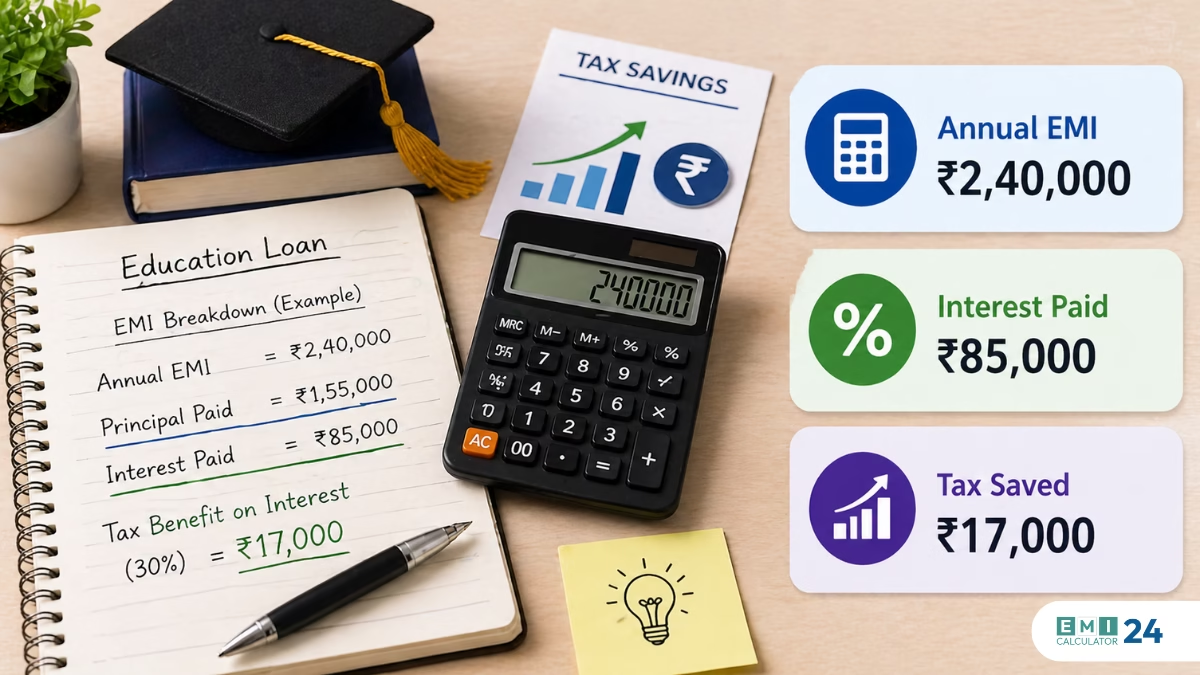
Aman pays ₹2,40,000 yearly toward education loan EMI.
Out of this:
- Principal = ₹1,55,000
- Interest = ₹85,000
Aman can claim deduction only on ₹85,000.
If Aman falls in 20% tax slab:
Tax saved = ₹85,000 × 20% = ₹17,000 (approx.)
That is real yearly savings.
Section 80E vs Section 80C (Important Difference)
| Feature | Section 80E | Section 80C |
|---|---|---|
| Applies To | Education loan interest | Investment + principal options |
| Deduction Type | Interest only | Multiple deductions |
| Max Limit | No limit | ₹1.5 lakh |
| Tax Regime | Old only | Old only |
Section 80E is focused only on education loan interest, while Section 80C covers broader tax-saving options.
Common Mistakes to Avoid While Claiming 80E
Avoid these common mistakes: ⚠️
- Claiming full EMI instead of interest only
- Choosing new tax regime
- Using personal loan as education loan
- Missing lender interest certificate
- Claiming beyond 8 years
- Assuming parents can claim without repayment proof
FAQs on Education Loan Tax Benefit Under Section 80E
These common questions about Education Loan Tax Benefit under Section 80E can help avoid filing mistakes.
Q1: Can I claim Section 80E for principal repayment?
No, only interest paid is eligible.
Q2: Can parents claim tax benefit under Section 80E?
Yes, if they are co-borrower and repay the loan.
Q3: Is Section 80E available in the new tax regime?
No, only old tax regime allows it.
Q4: Can I claim Section 80E for foreign education loan?
Yes, if it qualifies as higher education loan.
Q5: Is there any maximum deduction limit under Section 80E?
No, there is no upper limit.
Q6: Can I claim Section 80E if loan is taken from relatives?
No, loans from relatives do not qualify.
Q7: How many years can Section 80E be claimed?
Up to 8 years from repayment start.
Q8: What documents are needed to claim Section 80E?
Mainly the lender’s interest certificate and repayment proof.
Final Takeaway: Is Section 80E Worth Claiming?
Yes — Education Loan Tax Benefit under Section 80E is absolutely worth claiming. ✅
If you are already paying education loan EMI, skipping this deduction means missing a legal tax-saving opportunity.
For students, parents, and salaried co-borrowers, this benefit can reduce taxable income, lower effective loan cost, and improve repayment planning.
Used correctly, Education Loan Tax Benefit under Section 80E is not just a tax rule — it is a smart financial advantage for every education loan borrower in India.